How I Work
Expressive arts psychotherapy is relational work. It begins with the relationship between us: the trust we build, the presence we create together, and the space that allows you to explore what needs attention.
We work through dialogue, mindfulness, somatics, and the arts. We follow what's alive in the room and what the moment asks for. The process is responsive, attuned, and shaped by what you bring.
What is expressive arts psychotherapy?
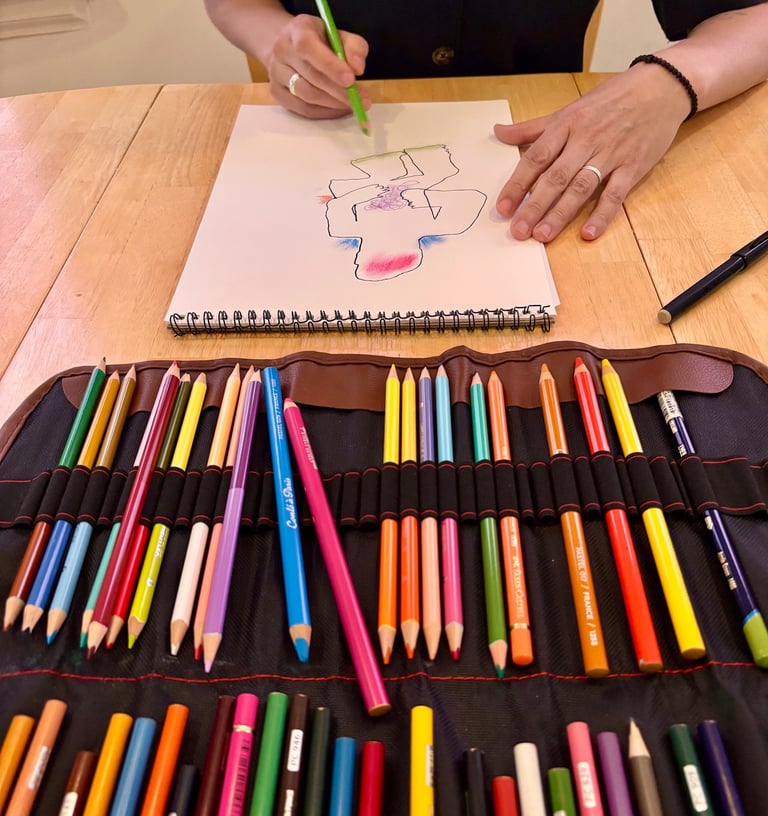
Expressive arts psychotherapy is a form of relational psychotherapy that uses the arts alongside dialogue as pathways to understanding, expression, and healing. The sessions can include movement, visual art, writing, music, sound, and/or drama.
No artistic experience is necessary—it's about the process, not the skill. In session, we can use the arts to go deeper into a theme, or as a way of stepping outside and gaining a new perspective.
You don't need to be an artist or a "creative" to do this work. You just need to be willing to be present and curious.
What I work with
Self-worth and self-esteem
What am I worth when old stories say I'm not enough? How do I unlearn what I've been told about who I am?
This work often involves exploring the origins of self-criticism, and reclaiming a sense of inherent worth.
Relationship patterns
Why do I keep ending up in the same dynamic? How do I set boundaries without losing connection? What does it mean to honour myself and stay in relationship?
We explore patterns with family, friends, partners, and colleagues. We notice what's inherited, what's learned, and what can change.
Identity, belonging, and culture
Who am I in relation to my culture, my family, my environment? What does it mean to belong when belonging feels complicated?
I work with people navigating questions of cultural identity, reclamation, and reconnection. This includes people exploring what's been lost, silenced, or disconnected across generations.
Your relationship to the world
How do I show up in the world? What is my relationship to my environment, my community, the larger systems I'm part of?
This might include exploring privilege, marginalisation, disconnection from land or culture, or what it means to live with integrity in a complex world.
Trauma and healing
Trauma lives in the body as much as the memory. Somatic and arts-based approaches offer ways to process what's been held physically and emotionally, not only cognitively.
I work with people navigating domestic violence, complex trauma, intergenerational trauma, grief, and loss.
Life transitions
Divorce, career change, loss, migration, becoming a parent, aging. The moments when life reshapes itself can be disorienting even when they're chosen. Therapy offers a space to find footing, make meaning, and move forward with clarity.
Caregiving and burnout
Caregiving, especially parenting, is profound, exhausting, and often invisible work. Therapy offers space that is genuinely yours: to process, to rest, to reconnect with yourself beyond the role.
What to expect in a session
Sessions are 50 minutes. I work with individuals aged 8 and up: children, youth, adults, and elders.
Every session is different. We might begin with a check-in, a grounding practice, or a moment of stillness. From there, we follow what feels alive. Sometimes that means talking for the full session. Sometimes it means drawing, moving, writing, or working with sound. There is no single format. The work is responsive to what you bring and what the moment asks for.
I offer sessions online across Ontario, and in person at the Village Healing Centre in Toronto's west end.
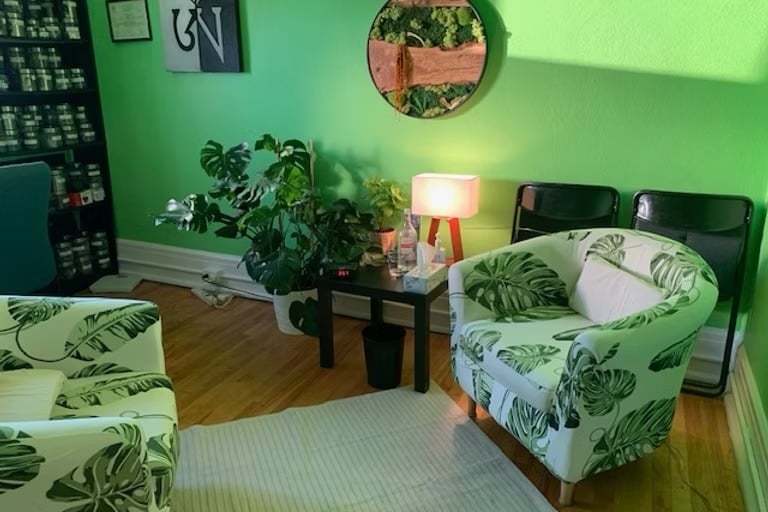
The therapy room at Village Healing Centre in Toronto's west end
Frequently asked questions
Do I need to be creative or artistic to do expressive arts therapy?
Not at all. This work is not about making good art. It's about using creative processes as a way of exploring and expressing experience. The only thing you need is curiosity and a willingness to try.
Will we talk in sessions, or is it all art-making?
Both. Expressive arts psychotherapy is a form of relational psychotherapy, which means dialogue is central. We also use movement, image, sound, and other creative forms when they serve the work. Some sessions are primarily conversation. Others involve more making. We follow what's needed.
How is this different from talk therapy?
Talk therapy works primarily through language and cognitive insight. Expressive arts psychotherapy also includes the body, the arts, and other ways of knowing.
This can be particularly valuable when experiences are hard to put into words, when the body is holding something the mind hasn't yet processed, or when insight alone isn't creating the shift you're looking for.
Is expressive arts therapy evidence-based?
Yes. There is a growing body of research supporting the effectiveness of arts-based and somatic therapies for trauma, anxiety, depression, grief, and relational challenges. Expressive arts psychotherapy draws on well-established traditions in humanistic, somatic, and relational psychotherapy.
Can I do this work online?
Yes. Online sessions work well for many people. Some elements may be adapted slightly, but the full range of expressive arts approaches can be used effectively in an online format.
What is the Village Healing Centre?
The Village Healing Centre is a community-focused wellness space in Toronto's west end where I offer in-person sessions. It's a warm, grounded space designed to support healing.
What does trauma-informed and neuro-affirming mean?
Trauma-informed practice means understanding how trauma affects the nervous system, the body, and relationships, and structuring therapy in ways that honour safety, choice, and agency.
Neuro-affirming practice means working from the understanding that neurodiversity is not pathology, it's difference. Therapy should adapt to how your brain works, not the other way around.
How long does therapy take?
This varies enormously. Some people find benefit in 8 to 12 sessions. Others work longer-term. We'll talk openly about what feels right as we go.
How do I get started?
Book a free 20-minute consultation using the link below, or email bpallomina@gmail.com.
Ready to begin?
Bee offers a free 20-minute consultation to anyone considering therapy. It's a chance to meet, ask questions, and decide together if this feels like a good fit.
or email bpallomina@gmail.com

Bee Pallomina, RP
Expressive Arts Therapist
Toronto, Ontario | Online across Ontario
About | How I Work | Fees & Getting Started | Blog
Member: CRPO, OEATA